
This week’s question is from Aaron via the form. Aaron asks:
In the song “Big Poppa” Notorious BIG attempts to entice a girl to rendezvous with his crew at the bar around 2 with an offer of “cheese, eggs and Welch’s grape.” Did he have to pay Welch’s for the use of their brand in his lyrics? Do music artists fall under the same rules as movies and tv about product usage?
Great question, Aaron!
I’ll start off by saying the following is a simplified explanation of use of trademarks. I love them, but intellectual property attorneys rank up there with tax attorneys in the “UM ACTUALLY” camp of lawyers. They can’t help it, they’re specialists! Think of me as your local primary care physician and think of IP lawyers as brain surgeons. Their area of law is incredibly intricate, which, naturally, leads them to hang their hat on technicalities. It’s why we love them and why we pay them the big bucks to watch our artistic backs.
So here’s the quick and dirty on using brands in songs.
Two laws govern the use of trademarks in media – the Lanham Act and the Federal Trademark Dilution Act (FTDA). The Lanham Act protects trademark holders from, among other things, trademark infringement, trademark dilution, and false advertising. The FTDA creates a way to sue in federal court to protect famous marks from unauthorized use; to prevent others from trading upon the goodwill and established renown of such marks; and to prevent dilution of the distinctive quality of such marks.
The purpose of both of these laws is to protect the commercial use of words and symbols. The law that runs counter to those laws is a big one – the First Amendment. Since the government “shall make no law …abridging the freedom of speech,” courts have been hesitant to bar speech simply because it mentions the name of a brand.
The test courts use to balance the protections of the Lanham Act against the free speech guaranteed by the First Amendment was originally created in a lawsuit from Ginger Rogers, the famous movie star and dancer. It’s now known as the Rogers test.
The Rogers test poses two questions to determine whether the Lanham Act wins when it is pitted against the First Amendment. The first question is whether the offending work’s use of a trademark has some artistic relationship to the work. The second question is whether that use explicitly misleads consumers.
In Rogers, the Second Circuit Court of Appeals held that the Lanham Act “should be construed to apply to artistic works only where the public interest in avoiding consumer confusion outweighs the public interest in free expression.” The court refused to ban someone from using a name or brand in a work simply because it was protected by a trademark. The use had to ALSO be confusing to consumers in order for the court to bar the speech.
The Ninth Circuit adopted this standard in its ruling on that one-hit-wonderful song “Barbie Girl”.
In the Barbie Girl case, the use of the trademark “Barbie” did not “explicitly mislead as to the source of the work” and did not “explicitly or otherwise, suggest that it was produced by Mattel.” That was enough for Mattel to lose at an early stage of litigation – because the use of the trademark in the song did not mislead a listener as to the source of the work or suggest it was produced by the owner of the trademarked item. Nobody heard that song and thought Mattel wrote it or sang it.
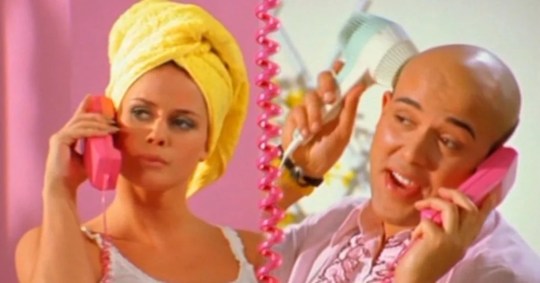
The Barbie Girl decision also applied the other law, the FTDA. One of the exemptions to the FTDA that allows someone to use a trademark is non-commercial use. But that begs the question — Is using a trademark in a song commercial or non-commercial? A song like “Barbie Girl” is art (just barely), created to express Aqua’s feelings on Barbie. But it’s also a product that’s being sold – back then, via CD singles at the local Sam Goody.
The court determined that when a song’s commercial purpose is “inextricably entwined expressive elements,” the song should be allowed to enjoy full First Amendment protection. Since the creative expression of Aqua singing about being undressed anywhere existed alongside the purpose of selling records, the Ninth Circuit held that the song “Barbie Girl” was not purely commercial speech. Therefore, Mattel lost and couldn’t prevent the monstrosity of “Barbie Girl” from continuing its onslaught against our ears.
The Rogers test was recently applied to protect video game maker Activision Blizzard when it used AM General’s Humvee military vehicle in its Call of Duty video game. Is using a trademarked car in a video game commercial or non-commercial?
Because the Humvees were there to make the gameplay more realistic, the court concluded that was “artistic expression” sufficient to satisfy the first question in the Rogers test.
As to the second question, the court held that the Humvee was not “explicitly misleading” and also, even if it was a little bit misleading, “an artistically relevant use will outweigh a moderate risk of confusion where the contested user offers a ‘persuasive explanation.’” Activision Blizzard explained their use of the Humvees persuasively: Humvees are the kind of vehicles that the real military uses, so they chose to use those vehicles to be as realistic as possible.
Despite these lawsuits, many brands actually like being mentioned in hit songs. Taylor Swift frequently name drops brands in her songs, including Polaroid and Band-Aid, which benefits the brands and sometimes leads to partnerships.
When Katy Perry released “Harleys in Hawaii” she did not inform Harley-Davidson of the song’s title in advance. Still, the company relished the opportunity to access a younger generation of riders and even provided motorcycles for us in the music video. The real illegal action in this song is that it wasn’t a bigger success. That song fuckin’ SLAPS!
There are really two ways for an artist to get in trouble by mentioning a brand in their songs. The first, as we discussed above, is mentioning a product in a way that would confuse consumers that the brand was responsible for the song.
The second way is mentioning a brand or product in a bad light. For instance, I would not recommend writing a song called Taco Bell Gives Everyone Diarrhea Every Single Time They Eat There. Just like people can sue for untrue statements about them that cause harm, corporations can also sue for defamation. Taco Bell would have to show that the published material has caused or is likely to cause financial losses. That may be a stretch given that Taco Bell = diarrhea is a meme. Doesn’t mean they couldn’t still try.
This is why a banger like “Combination Pizza Hut and Taco Bell” can exist in all its glory. It is not making a negative statement about the conjunctive restaurant chains, and no one would be confused into thinking that YUM! Brands wrote or sang that song.
Since Biggie mentioned using Welch’s grape juice as a way to seduce women to rendezvous with him in the middle of the night, we can assume this is a positive mention as he believes it to be a delicious pairing with his T-bone steak and cheese eggs. Is it “cheese (COMMA) eggs”? Like, is he eating a T-bone steak, cheese, AND eggs, then pairing it all with Welch’s grape juice? Or is he eating a T-bone steak and eggs MIXED WITH cheese to pair with the Welch’s? The world may never know.
But at no point would anyone think that Welch’s grape juice wrote that song. Just listen to it. Only Biggie could come up with such effusive lyrics and such dope beats.
I hope that answers your question, Aaron!
Got a question? Submit it here. They can be legal what-if questions, questions on current events, or questions about the legality of actions in TV shows or movies you’ve seen. I never ever want to answer your personal legal questions, so don’t send those. Love you, but I don’t do that.
***
This piece first appeared in Sunday Morning Hot Tea. Subscribe so you don’t miss another piece.