This was a great week for art in my world. First, Bo Burnham, one of my all-time favorite comics released a special on Neflix called Inside. He wrote, performed, shot, and edited it entirely on his own during the pandemic. If you haven’t watched it, just put this newsletter down, go watch it then come back. Or don’t. I mean… it’s your life.
Then my forever imaginary boyfriend John Mayer released a new song called “Last Train Home” the first single from his new album to be released in July. I don’t have to tell you I have played this song on repeat constantly since it was released on Friday.
I will avoid giving any spoilers about Bo’s special because I wholeheartedly believe it is something you should just let happen to you with no warning. I will, however, say I related deeply to a lot of the themes. One song asked whether now, amidst a global pandemic and unprecedented social unrest (to put it mildly), is a good time to be making comedy or, really, creating anything. It also addressed the feeling of wanting to complete certain feats by a certain age.
I get those feelings a lot, too. Feelings like how did I end up at this age without having crossed tasks off this imaginary list of milestones I created for myself? A silly thought, I know. My older clients, for instance, always tell me I’m a baby when they find out my age. On a grand scale, I guess I am a baby, just 34. Wow, how old am I to say just thirty-four. As a kid, anything over 30 felt like a death sentence, the punchline of jokes. “Everything goes downhill after 30!” and the audience roars in recognition.
John Mayer’s new song explores similar themes:
I’m not a fallen angel
I just fell behind
I’m out of luck and I’m out of time.
The whole song feels like a last call – get on board or get out of the way. He’s “running for the last train home.”
Funny the ubiquitousness of that feeling – like we have to accomplish X feat by Y date. The train is leaving the station. Time to go. Every one of us trying to cram it all in before the credits roll. It’s a dizzying feeling, one that can cause you to miss things if you don’t stop and take a look around a minute, like Ferris taught us.
In my mind, there’s this giant countdown clock hovering over each of our heads, ticking down till there’s nothing left. We can’t see the digits, but we know they’re going down, not up.
I get to feeling guilty sometimes for wanting so often. I want to accomplish things, to do things, to go places. The most human of emotions is yearning, yet somehow, we punish ourselves for leaning into it.
The other pang of guilt I get comes with not enjoying the get. After running for a train, when I finally catch it, it takes a lot of work on my end to sit back and enjoy the ride for a minute. Most times I just look forward to what station we’re pulling into and which train I can hop on next.
To combat this (and at the behest of my therapist), I started gratitude journaling. I use a purple, leather-bound Michelle Obama journal gifted to me by Christie. The pages are interspersed with photos of the former first lady and inspirational quotes. I write things I am grateful for on one page each night, then things I want to accomplish and manifest on the subsequent pages. It’s only now, upon reflection, that I realize there’s about a 3-to-1 ratio of the manifestation/goal pages to the gratitude pages. Gotta keep trying, I guess.
I often wonder whether I’ll ever hit a place where I am satisfied, where my thank-you pages outnumber my to-do pages. I wonder whether my restless heart is destined to operate in this constant state of insatiable hunger. If one is good, then ten is better, you know?
I hope maybe there is a place I can arrive at and rest, though I doubt it exists. Daddy would always quote Butch Cassidy and the Sundance Kid: “You just keep thinking, Butch. That’s what you’re good at.” He knew it and so do I: the wheels between my ears crank on, no matter the quantity of output.
It’s not a bad place to dwell. Sure, it can get exhausting, but I am the happiest when I am creating stuff. Working on the show, working on this newsletter, working on other stuff I can’t tell you about yet.
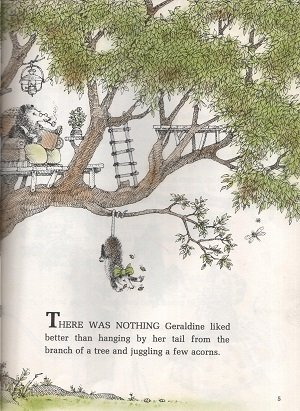
The other day I picked up and read a children’s book I had on my shelf. It’s called Just the Thing for Geraldine. I love this book, not just because my mom used to read it to us and do silly voices. The hero’s journey that the main character embarks upon is a lesson to us all. For those of you who have never read it, let me summarize.
We open on our hero, Geraldine, doing what she loves and what she does best: hanging upside down by her tail juggling acorns. I should clarify that Geraldine is a possum (spelled in the book without the O). By page 2, her dreams are crushed: “Her parents told her there was more to life than juggling.”
Ain’t that a bitch.
They send her to dance school, hoping it will change her, make her “more ladylike and graceful.” Spoiler alert for this book published in 1974: Geraldine sucks at ballet. Her parents then force her into weaving school, telling her she can make creations for her future children. She sucks at that, too. She is then forced to try her hand at art in a sculpting class. Being that it is not art she pursued on her own accord, she sucks at that, too.
Despondent at what she perceives as her repeated failures and inadequacies, Geraldine returns to that place she feels safest, where she feels like the best version of herself: hanging upside down from a branch juggling.
Though her siblings finally recognize her natural talents, her parents still try to rope her into something else she was not cut out for – singing. Finally fed up, Geraldine refuses the life path her parents tried imposing on her. Instead, she embraces who she is – a juggler – and sets up her own juggling school. The book ends there, but not for me. I like to imagine Geraldine went on to train thousands of other forest animals. I also imagine she recognized the students who were forced into the class by their parents, sending them home with an earful of advice and a whole lot of encouragement.
I relate deeply to this marsupial. Sure, I can’t juggle, and I don’t have a tail. But the sentiment is the same.
How many times have we found ourselves as despondent as she, feeling like failures not due to our own inadequacies, but because we were – for lack of a better term – putting our square pegs into round holes? Forcing ourselves to endure weaving class when we knew we should have been juggling.
If, as I believe, we are all operating beneath that great invisible countdown clock above each of our heads, are we not better served juggling till the time runs out? We can’t spend time trying to adapt to expectations we never set for ourselves.
One of my favorite podcasts is “The Moment with Brian Koppelman”. Without knowing, BK changed my life. (Quick, somebody forward this to him so he knows.) After graduating law school and passing the bar, I had an existential crisis. What was I? A lawyer? Sure, ok. What does that even mean? What did I used to be? What was I, deep down, that I never stopped being? What was my juggling?
Writing. Storytelling. Doing comedy.
The answer was there, I had just crammed it down while I tying myself up in knots in a weaving class I told myself I needed to take.
On his podcast, Koppelman talks about how he got started in the entertainment business. He was a music executive who had a repressed writer inside. He nursed that writer, named it for what it was, and gave himself a space to work.
Along with his writing partner, they created the script for the film Rounders and sold it to a studio. He had to get up early before work to do the thing each day, but he did it. In order to give ourselves permission to dedicate time to a pursuit, we can’t tell ourselves there’s more to life than our juggling. We have to name what we are and claim our space in the universe in order to feel justified spending so much time on our thing.
When I first started listening, BK said something on the show that punched me right in the gut: “Do the thing that makes you feel most alive and most like yourself.” Doing it is one thing, and it’s not easy. But maybe the step before doing it is declaring it as a space in which we belong. That is much harder. To label yourself a writer, or a juggler, or a model, or a dancer, or an artist takes great courage. It is the most vulnerable position to take: telling the whole world your deepest desire.
I just started Seth Godin’s book The Practice this week, a book inspired by his interactions with Koppelman both on and off the podcast. It’s full of gems, but one in particular caught me. He quotes the Bhagavad-Gita: “It is better to follow your own path, however imperfectly, than to follow someone else’s perfectly.” It’s quite an eloquent way to say if you’re a juggler, stick to juggling.
Bo’s special and John’s music and BK’s podcast and Seth’s book all started with each of them answering that question – who am I to create something? They tell you right there in the work: Bo is a comedian, a filmmaker. John is a songwriter, a singer, a musician. BK is a writer, a creative coach. Seth is a writer. It starts with tossing off the externally imposed labels and stepping into that vulnerable place of declaring who you are to the world. It’s not easy, of course. But the alternative is never saying a word while the clock still ticks on above us.
It’s much easier to listen to those possum-parents in our lives. These are not necessarily our own parents. They can be the governors of our social norms. Those who expect us to do what they tell us we should be doing. Doing that is not sustainable in the long term. When we find ourselves failing in a class we were never meant to take, that probably means we shouldn’t be in that class. Instead we should be hanging upside down on our branches. Because even if we can’t see or hear it, that clock is there. One day it’ll hit quadruple zeros. In the meantime, all we can do is hang on to our acorns, no matter how many people tell us to drop them.
***
This piece first appeared in Sunday Morning Hot Tea. Subscribe so you don’t miss another piece.